88/5.0/HO-Codes-33&44??

Discussion in 'Fox 5.0 Mustang' started by horseballz, Oct 28, 2009.

  1. horseballz Member

    Member Since:
    Oct 1, 2009
    Message Count:
    504
    Likes Received:
    0
    Trophy Points:
    16
    88/5.0/HO-Codes-33&45??

    Hi,
    Went through procedure for pulling codes 3 times to make sure I was seeing what I thought I was seeing.
    KOEO: all I got was code 11
    KOER: code-33 & code-45
    These seem to tell me: 33=EGR not opening properly
    45=Air not diverting/EDIS or DIS system failure
    Different charts say different things about these codes but they seem to point to generally similar problems. Being an absolute "virgin" on these cars and systems what is my next step to enable me to be deflowered gently and not chase my tail by simply buying and replacing parts until the problem goes away? In other words, how do I troubleshoot to find just what needs to be repaired and or replaced?
    TIA
    Gene
  2. Simple88GT New Member

    Member Since:
    Mar 19, 2008
    Message Count:
    83
    Likes Received:
    0
    Trophy Points:
    0
    your best bet is to do a search, on here, using the codes you have and look for a member by the name of Jrichker, He is the man when it comes to the codes. I normally do that. I am sure he will chime in shortly but until then I suggest searching.

    -Josh-
  3. jrichker StangNet's favorite TOOL

    Member Since:
    Mar 10, 2000
    Message Count:
    18,447
    Likes Received:
    11
    Trophy Points:
    88
    Code 33 - Insufficient EGR flow detected.
    Look for vacuum leaks, cracked vacuum lines, failed EGR vacuum regulator. Check to see if you have 10” of vacuum at the EGR vacuum connection coming from the intake manifold. Look for electrical signal at the vacuum regulator solenoid valves located on the rear of the passenger side wheel well. Using a test light across the electrical connector, it should flicker as the electrical signal flickers. Remember that the computer does not source any power, but provides the ground necessary to complete the circuit. That means one side of the circuit will always be hot, and the other side will go to ground or below 1 volt as the computer switches on that circuit.
    Check for resistance between the brown/lt green wire on the EGR sensor and pin 27 on the computer: you should have less than 1.5 ohm.

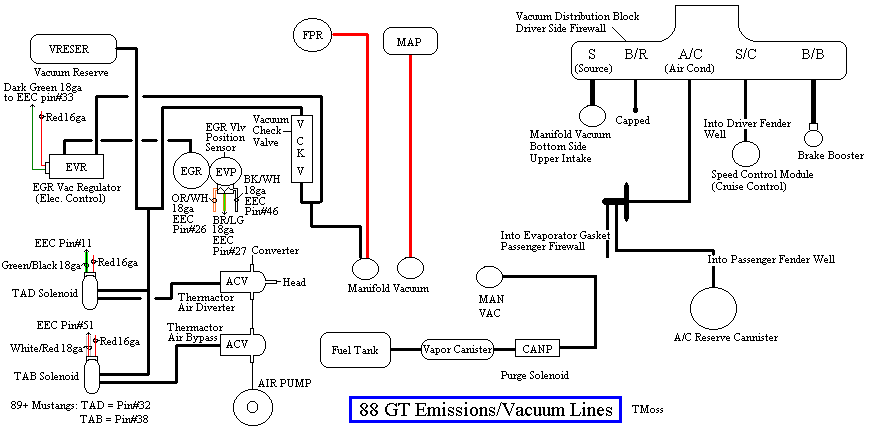
    See the following website for some help from Tmoss (diagram designer) & Stang&2Birds (website host)

    http://www.veryuseful.com/mustang/tech/engine/images/fuel-alt-links-ign-ac.gif

    http://www.veryuseful.com/mustang/tech/engine/images/88-91eecPinout.gif


    EGR test procedure courtesy of cjones

    to check the EGR valve:
    bring the engine to normal temp.

    connect a vacuum pump to the EGR Valve or see the EGR test jig drawing below. Connnect the test jig or to directly to manifold vacuum.

    Do not connect the EGR test jig to the EVR (Electronic Vacuum Regulator).


    apply 5in vacuum to the valve. Using the test jig, use your finger to vary the vacuum

    if engine stumbled or died then EGR Valve and passage(there is a passageway through the heads and intake) are good.

    if engine did NOT stumble or die then either the EGR Valve is bad and/or the passage is blocked.

    if engine stumbled, connect EGR test jig to the hose coming off of the EGR Valve.
    Use your finger to cap the open port on the vacuum tee.
    snap throttle to 2500 RPM (remember snap the throttle don't hold it there).
    did the vacuum gauge show about 2-5 in vacuum?
    if not the EVR has failed

    EGR test jig
    [IMG]

    The operation of the EGR vacuum regulator can be checked by using a test light applied across the wiring connector. Jumper the computer into self test mode and turn the key on but do not start the engine. You will hear all the actuators (including the EVR vacuum regulator) cycle. Watch for the light to flicker: that means the computer has signaled the EGR vacuum regulator successfully.


    Codes 44 & 94 - AIR system inoperative - Air Injection. Check vacuum lines for leaks, & cracks.

    Revised 28-Oct-2009 to correct code definitions and operation.

    Code 44 RH side air not functioning.
    Code 94 LH side air not functioning.

    The computer uses the change in the O2 sensor readings to detect operation of the Thermactor control valves. When the dump valve opens, it reduces the O2 readings in the exhaust system. Then it closes the dump valve and the O2 readings increase. By toggling the dump valve (TAB), the computer tests for the 44/94 codes.

    Failure mode is usually due to a clogged air crossover tube, where one or both sides of the tube clog with carbon. The air crossover tube mounts on the back of the cylinder heads and supplies air to each of the Thermactor air passages cast into the cylinder heads. When the heads do not get the proper air delivery, they set codes 44 & 94, depending on which passage is clogged. It is possible to get both 44 & 94, which would suggest that the air pump or control valves are not working correctly, or the crossover tube is full of carbon or missing.

    Testing the system:
    Disconnect the big hose from smog pump: with the engine running you should feel air output. Reconnect
    the smog pump hose & apply vacuum to the first vacuum controlled valve: Its purpose is to either dump
    the pump's output to the atmosphere or pass it to the next valve.

    The next vacuum controlled valve directs the air to either the cylinder heads when the engine is cold or
    to the catalytic converter when the engine is warm. Disconnect the big hoses from the back side of the
    vacuum controlled valve and start the engine. Apply vacuum to the valve and see if the airflow changes
    from one hose to the next.

    The two electrical controlled vacuum valves mounted on the rear of the passenger side wheel well turn the
    vacuum on & off under computer control. Check to see that both valves have +12 volts on the red wire.
    Then ground the white/red wire and the first solenoid should open and pass vacuum. Do the same thing to
    the light green/black wire on the second solenoid and it should open and pass vacuum.

    Remember that the computer does not source power for any actuator or relay, but provides the ground
    necessary to complete the circuit. That means one side of the circuit will always be hot, and the other side
    will go to ground or below 1 volt as the computer switches on that circuit.


    The computer provides the ground to complete the circuit to power the solenoid valve that turns the
    vacuum on or off. The computer is located under the passenger side kick panel. Remove the kick panel &
    the cover over the computer wiring connector pins. Check Pin 38 Solenoid valve #1 that provides vacuum
    to the first Thermactor control valve for a switch from 12-14 volts to 1 volt or less. Do the same with pin
    32 solenoid valve #2 that provides vacuum to the second Thermactor control valve. Starting the engine
    with the computer jumpered to self test mode will cause all the actuators to toggle on and off. If after
    doing this and you see no switching of the voltage on and off, you can start testing the wiring for shorts to
    ground and broken wiring. An Ohm check to ground with the computer connector disconnected & the
    solenoid valves disconnected should show open circuit between the pin 32 and ground and again on pin 38
    and ground. In like manner, there should be less than 1 ohm between pin 32 and solenoid valve #2 and pin
    38 & Solenoid valve #1.

    If after checking the resistance of the wiring & you are sure that there are no wiring faults, start looking at the
    solenoid valves. If you disconnect them, you can jumper power & ground to them to verify operation. Power &
    ground supplied should turn on the vacuum flow, remove either one and the vacuum should stop flowing.

    Typical resistance of the solenoid valves is in the range of 20-70 Ohms.

    See the following website for some help from Tmoss (diagram designer) & Stang&2Birds (website host)

    http://www.veryuseful.com/mustang/tech/engine/images/fuel-alt-links-ign-ac.gif

    http://www.veryuseful.com/mustang/tech/engine/images/88-91eecPinout.gif

    See http://forums.stangnet.com/attachment.php?attachmentid=50636&d=1180923382 for a very nice drawing of the Thermactor Air System (smog pump) plumbing

    If you have a catalytic converter H pipe, you need to fix these codes. If you don't, then don't worry about them
  4. liljoe07 New Member

    Member Since:
    Feb 18, 2009
    Message Count:
    1,034
    Likes Received:
    0
    Trophy Points:
    0
    JR.....Remember, Code 94 and 44 are bank specific codes. With 44 being the only code for the Thermactor, I tend to think the Crossover tube at the back of the heads is clogged on the passenger side. Either in the Tube, or the Port on the head itself
  5. horseballz Member

    Member Since:
    Oct 1, 2009
    Message Count:
    504
    Likes Received:
    0
    Trophy Points:
    16
    CORRECTION Codes 33 & 45

    jrichker & liljoe07,
    I was a total dumb a$$ when I first posted this question :doh: I put in the title that the codes were: 33 & 44, but in the body of the post I "CORRECTLY" listed them as: 33 & 45. By the time I noticed the error, I had already submitted the post and therefore could not edit the title.:Damnit: I really appreciate all of your effort to help me and sincerely apologize for giving incorrect info. I hope you won't hold it against me? By the way, do threads in this forum have a limited life span? The first post I started a few days back appears to have disappeared. I only ask, as many times I refer back to earlier threads for info.
    Thanks again for the replies,
    Gene
  6. HISSIN50 "How long do you think it'll take me to get any he

    Member Since:
    Jul 2, 2003
    Message Count:
    30,794
    Likes Received:
    0
    Trophy Points:
    76
    The tune-up parts thread is your only recent one in 5.0 Tech that I see, other than the Mclaren thread.

    Sometimes if two thread topics are too similar or overlap too much, a smart moderator will merge them together.
  7. jrichker StangNet's favorite TOOL

    Member Since:
    Mar 10, 2000
    Message Count:
    18,447
    Likes Received:
    11
    Trophy Points:
    88
    Please note the correction and revision date in my post. I am still pondering this puzzle, so there may be more changes in the future.

    Joe R.
  8. horseballz Member

    Member Since:
    Oct 1, 2009
    Message Count:
    504
    Likes Received:
    0
    Trophy Points:
    16
    jrichker & HISSIN50,
    Thanks for the testing info. Yes we currently have al 4 original cats, but my bro has the car registered in FL where they don't smog or inspect and he thinks he wants to either bag the cats altogether with an "off road" pipe (I'm not sure this is a good idea, living so close to CRAZYFORNIA) or go to a set up with only 1 cat per side. Being a newbie, I'm not aware of the ups/downs or pros/cons of such a set up. As far as the missing post, the Mclaren one is what I was referring to. Am I just blind or did it disappear?
    Thanks
    Gene
  9. liljoe07 New Member

    Member Since:
    Feb 18, 2009
    Message Count:
    1,034
    Likes Received:
    0
    Trophy Points:
    0
    10-4 JR :flag:
  10. liljoe07 New Member

    Member Since:
    Feb 18, 2009
    Message Count:
    1,034
    Likes Received:
    0
    Trophy Points:
    0
    Posted via Mobile Device

    Code 45 is Thermactor Air upstream during the self test.

    I'd look for a sticking Diverter Valve or a sticking TAD solenoid.

    You would need to unhook the diverter valve from the crossover tube going to the back of the heads. Unhook the vac line on top of the Diverter Valve and cap it off. Then start the engine. No air should be passing through it at that point.

    Next, would be to check the TAD solenoid. Unplug its electrical connector. Start engine, then go to the Vacuum line you pulled off of the diverter valve, and feel for a vacuum. With the solenoid unpluged, no vac should be present.
  11. HISSIN50 "How long do you think it'll take me to get any he

    Member Since:
    Jul 2, 2003
    Message Count:
    30,794
    Likes Received:
    0
    Trophy Points:
    76
  12. horseballz Member

    Member Since:
    Oct 1, 2009
    Message Count:
    504
    Likes Received:
    0
    Trophy Points:
    16
    Thanks HISSIN50,
    Even after you put up that link to my older post I couldn't find it in the list, even though I could link to it. :shrug: I was at least half smart enough to go into "User CP" and discover that I had a setting at Forum Default that apparently only shows "X" number of days of threads. I don't really care about that particular thread, however I wanted to figure out how to make sure I could view older stuff. Again, thanks for helping out a dumba$$ newbie to the website. :hail2:
    Gene
  13. horseballz Member

    Member Since:
    Oct 1, 2009
    Message Count:
    504
    Likes Received:
    0
    Trophy Points:
    16
    Okay, here's my findings,
    1. Manifold vacuum to EGR vacuum solenoid reads 14-15 inches (crappy Harbor freight gauge), solenoid appears to work, applying 5 inches +/- vacuum to EGR does not cause engine to stumble or die.

      Conclusion=EGR valve faulty or EGR valve and/or passages clogged.
      A-Once EGR is removed, can it be cleaned (if clogged up) and tested for proper operation?
      B-How do I clean the EGR passages if plugged/clogged?
    2. Air pump vacuum controlled dump valve operates as it should by applying/removing vacuum from it.
      A-Applying/removing power to/from electrically controlled vacuum valve for dump valve passes/closes vacuum flow.
      Conclusion=OK

    3. Vacuum controlled diverter valve switches air flow with vacuum applied/removed.
      A-Applying/removing power to electrically controlled vacuum valve for diverter valve causes no change in vacuum flow. Vacuum always flowing.
      Conclusion=Faulty or sticking electrically controlled vacuum valve.
      1-Is it possible to unstick this valve?
      2-Is this valve the same part as the EGR vacuum solenoid located right near it on the rear of the passenger side wheel well? I have not removed them yet, but by appearances and operation they seem the same and the parts joints here only list "EGR Vacuum Soleniod".
    Thanks in advance for all the help,
    Gene
  14. HISSIN50 "How long do you think it'll take me to get any he

    Member Since:
    Jul 2, 2003
    Message Count:
    30,794
    Likes Received:
    0
    Trophy Points:
    76
    I use a bore brush and mild solvent to clean EGR passages.

    If the the A.I.R. control valve has continuity between the inlet and outlet with power disconnected, I'd just get a new/used one. I suppose you could try to clean it but I never have tried. Someone else will know.
  15. horseballz Member

    Member Since:
    Oct 1, 2009
    Message Count:
    504
    Likes Received:
    0
    Trophy Points:
    16
    HISSIN50,
    Do you know if that valve is the same as the one for the EGR? Also, doe the intake need to be removed to clean out the EGR passages? If so, it might be a good excuse to do one of the intake upgrades I've been hearing about. :rolleyes: HHHMMMMM... I need to do more research, I think I read that upper/lower intake, throttle body etc. from a later Explorer is a good and easy upgrade?
    Thanks
    Gene
  16. jrichker StangNet's favorite TOOL

    Member Since:
    Mar 10, 2000
    Message Count:
    18,447
    Likes Received:
    11
    Trophy Points:
    88
    Some basic theory to clarify how things work is in order…

    EGR System theory and testing

    The EGR shuts off at Wide Open Throttle (WOT), so it has minimal effect on performance. The addition of exhaust gas drops
    combustion temperature, increases gas mileage and reduces the tendency of the engine to ping. It can also reduce HC emissions
    by reducing fuel consumption. The primary result of EGR usage is a reduction in NOx emissions.

    The EGR system has a vacuum source (line from the intake manifold) that goes to the EVR, computer operated electronic vacuum
    regulator. The EVR is located on the back of the passenger side shock strut tower. The computer uses RPM, Load. and some other
    factors to tell the EVR to pass vacuum to open the EGR valve. The EGR valve and the passages in the heads and intake manifold
    route exhaust gas to the EGR spacer (throttle body spacer). The EGR sensor tells the computer how far the EGR valve is open.
    Then computer adjusts the signal sent to the EVR to hold, increase or decrease the vacuum. The computer adds spark advance to
    compensate for the recirculated gases and the slower rate they burn at.


    [IMG]

    Troubleshooting:
    There should be no vacuum at the EGR valve when at idle. If there is, the EVR (electronic vacuum regulator) mounted on the
    backside of the passenger side wheelwell is suspect. Check the vacuum line plumbing to make sure the previous owner didn’t
    cross the vacuum lines.

    Diagram courtesy of Tmoss & Stang&2birds. (the diagram says 88 GT, but the EGR part is the same for 86-93 Mustangs)
    [IMG]

    The EGR sensor is basically a variable resistor, like the volume control on a radio. One end is 5 volt VREF power from the
    computer (red/orange wire). One end is computer signal ground (black/white), and the middle wire (brown/lt green) is the signal
    output from the EGR sensor. It is designed to always have some small voltage output from it anytime the ignition switch is the
    Run position. That way the computer knows the sensor & the wiring is OK. No voltage on computer pin 27 (brown/lt green wire)
    and the computer thinks the sensor is bad or the wire is broken and sets code 31. The voltage output can range from approximately
    .6-.85 volt.

    The EVR regulates vacuum to the EGR valve to maintain the correct amount of vacuum. The solenoid coil should measure 20-70
    Ohms resistance. The regulator has a vacuum feed on the bottom which draws from the intake manifold. The other vacuum line is
    regulated vacuum going to the EGR valve. One side of the EVR electrical circuit is +12 volts anytime the ignition switch is in the
    run position. The other side of the electrical circuit is the ground path and is controlled by the computer. The computer switches
    the ground on and off to control the regulator solenoid.


    EGR test procedure courtesy of cjones

    EGR test procedure courtesy of cjones

    to check the EGR valve:
    bring the engine to normal temp.

    connect a vacuum pump to the EGR Valve or see the EGR test jig drawing below. Connnect the test jig or to directly to manifold vacuum.

    Do not connect the EGR test jig to the EVR (Electronic Vacuum Regulator).


    apply 5in vacuum to the valve. Using the test jig, use your finger to vary the vacuum

    if engine stumbled or died then EGR Valve and passage(there is a passageway through the heads and intake) are good.

    if engine did NOT stumble or die then either the EGR Valve is bad and/or the passage is blocked.

    if engine stumbled, connect EGR test jig to the hose coming off of the EGR Valve.
    Use your finger to cap the open port on the vacuum tee.
    snap throttle to 2500 RPM (remember snap the throttle don't hold it there).
    did the vacuum gauge show about 2-5 in vacuum?
    if not the EVR has failed

    EGR test jig
    [IMG]

    To test the computer, you can use a test light across the EVR wiring connectors and dump the codes. When you dump the codes,
    the computer does a self test that toggles every relay/actuator/solenoid on and off. When this happens, the test light will flicker.

    Late Model Restoration has the Ford Racing M-12071-N302 kit with the EGR valve & sensor along with the ACT & ECT sensors for
    $45. See http://www.latemodelrestoration.com/iwwida.pvx?;item?item_no=M12071N302 1&comp=LRS for
    more details


    Thermactor Air System
    Some review of how it works...

    Revised 28-Oct-2009 to correct code definitions and operation.

    The Thermactor air pump (smog pump) supplies air to the heads or catalytic converters. This air helps break down the excess HC (hydrocarbons) and CO (carbon monoxide). The air supplied to the catalytic converters helps create the catalytic reaction that changes the HC & CO into CO2 and water vapor. Catalytic converters on 5.0 Mustangs are designed to use the extra air provided by the smog pump. Without the extra air, the catalytic converters will clog and fail.

    The Thermactor air pump draws air from an inlet filter in the front of the pump. The smog pump puts air into the heads when the engine is cold and then into the catalytic converters when it is warm. The Thermactor control valves serve to direct the flow. The first valve, TAB (Thermactor Air Bypass) or AM1 valve) either dumps air to the atmosphere or passes it on to the second valve. The second valve, TAD (Thermactor Air Diverter valve or AM2 valve) directs it to the heads or the catalytic converters. Check valves located after the TAB & TAD solenoids prevent hot exhaust gases from damaging the control valves or pump in case of a backfire. The air serves to help consume any unburned hydrocarbons by supplying extra oxygen to the catalytic process. The computer tells the Thermactor Air System to open the Bypass valve at WOT (wide open throttle) minimizing engine drag. This dumps the pump's output to the atmosphere, and reduces the parasitic drag caused by the smog pump to about 2-4 HP at WOT. The Bypass valve also opens during deceleration to reduce or prevent backfires.

    Code 44 RH side air not functioning.
    Code 94 LH side air not functioning.

    The computer uses the change in the O2 sensor readings to detect operation of the Thermactor control valves. When the dump valve opens, it reduces the O2 readings in the exhaust system. Then it closes the dump valve and the O2 readings increase. By toggling the dump valve (TAB), the computer tests for the 44/94 codes.

    Failure mode is usually due to a clogged air crossover tube, where one or both sides of the tube clog with carbon. The air crossover tube mounts on the back of the cylinder heads and supplies air to each of the Thermactor air passages cast into the cylinder heads. When the heads do not get the proper air delivery, they set codes 44 & 94, depending on which passage is clogged. It is possible to get both 44 & 94, which would suggest that the air pump or control valves are not working correctly, or the crossover tube is full of carbon or missing.


    [IMG]


    Computer operation & control for the Thermactor Air System
    Automobile computers use current sink technology. They do not source power to any relay, solenoid or actuator like the IAC, fuel pump relay, or fuel injectors. Instead the computer provides a ground path for the positive battery voltage to get back to the battery negative terminal. That flow of power from positive to negative is what provides the energy to make the IAC, fuel pump relay, or fuel injectors work. No ground provided by the computer, then the actuators and relays don't operate.

    One side of the any relay/actuator/solenoid in the engine compartment will be connected to a red wire that has 12-14 volts anytime the ignition switch is in the run position. The other side will have 12-14 volts when the relay/actuator/solenoid isn't turned on. Once the computer turns on the clamp side, the voltage on the computer side of the wire will drop down to 1 volt or less.

    In order to test the TAD/TAB solenoids, you need to ground the white/red wire on the TAB solenoid or the light green/black wire on the TAD solenoid.

    For 94-95 cars: the colors are different. The White/Red wire (TAB control) is White/Orange (Pin 31 on the PCM). The Green/Black wire (TAD control) should be Brown (pin 34 at the PCM). Thanks to HISSIN50 for this tip.

    To test the computer, you can use a test light across the TAB or TAD wiring connectors and dump the codes. When you dump the codes, the computer does a self test that toggles every relay/actuator/solenoid on and off. When this happens, the test light will flicker.

    Theory of operation:
    Catalytic converters consist of two different types of catalysts: Reduction and Oxidation.
    The Reduction catalyst is the first converter in a 5.0 Mustang, and the Oxidation converter is the second converter. The Oxidation converter uses the extra air from the smog pump to burn the excess HC. Aftermarket converters that use the smog pump often combine both types of catalysts in one housing.

    Now for the Chemistry...
    "The reduction catalyst is the first stage of the catalytic converter. It uses platinum and rhodium to help reduce the NOx emissions. When an NO or NO2 molecule contacts the catalyst, the catalyst rips the nitrogen atom out of the molecule and holds on to it, freeing the oxygen in the form of O2. The nitrogen atoms bond with other nitrogen atoms that are also stuck to the catalyst, forming N2. For example:

    2NO => N2 + O2 or 2NO2 => N2 + 2O2

    The oxidation catalyst is the second stage of the catalytic converter. It reduces the unburned hydrocarbons and carbon monoxide by burning (oxidizing) them over a platinum and palladium catalyst. This catalyst aids the reaction of the CO and hydrocarbons with the remaining oxygen in the exhaust gas. For example:

    2CO + O2 => 2CO2

    There are two main types of structures used in catalytic converters -- honeycomb and ceramic beads. Most cars today use a honeycomb structure." Quote courtesy of How Stuff Works (HowStuffWorks "Catalysts")

    What happens when there is no extra air from the smog pump...
    As engines age, the quality of tune decreases and wear causes them to burn oil. We have all seem cars that go down the road puffing blue or black smoke from the tailpipe. Oil consumption and poor tune increase the amount of HC the oxidation catalyst has to deal with. The excess HC that the converters cannot oxidize due to lack of extra air becomes a crusty coating inside the honeycomb structure. This effectively reduces the size of the honeycomb passageways and builds up thicker over time and mileage. Continuous usage under such conditions will cause the converter to fail and clog. The extra air provided by the Thermactor Air System (smog pump) is essential for the oxidation process. It oxidizes the added HC from oil consumption and poor tune and keeps the HC levels within acceptable limits.

    Newer catalytic converters do not use the Thermactor Air System (smog pump) because they are designed to work with an improved computer system that runs leaner and cleaner
    They add an extra set of O2 sensors after the catalytic converters to monitor the oxygen and HC levels. Using this additional information, the improved computer system adjusts the air/fuel mixture for cleaner combustion and reduced emissions. If the computer cannot compensate for the added load of emissions due to wear and poor tune, the catalytic converters will eventually fail and clog. The periodic checks (smog inspections) are supposed to help owners keep track of problems and get them repaired.
  17. horseballz Member

    Member Since:
    Oct 1, 2009
    Message Count:
    504
    Likes Received:
    0
    Trophy Points:
    16
    jrichker,
    It really kicks butt that you have done all this research to find this gerat info and it is so greatly appreciated. After I have a bit of time to digest it, I'm sure I will have at least a couple:rolleyes:more questions.
    Again, Thank You, Thank You, Thank You,:flag:
    Gene
  18. horseballz Member

    Member Since:
    Oct 1, 2009
    Message Count:
    504
    Likes Received:
    0
    Trophy Points:
    16
    Hey Guys,
    I'm headed to the boneyard to look for TAB & TAD solenoids for the Thermactor/Air Pump. What other vehicles might have these same solenoids?
    Thanks
    Gene

Share This Page